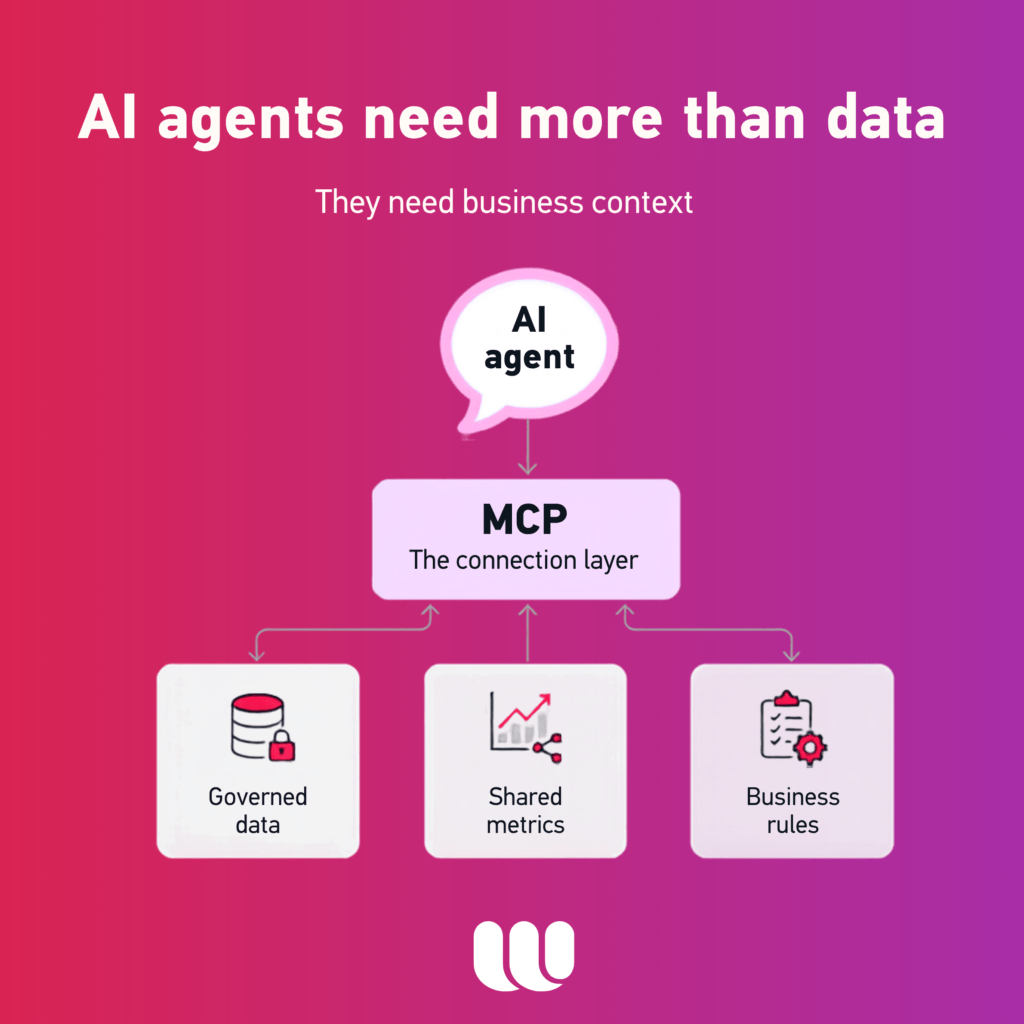
AI agents need more than access to data.
They need the business context that makes it meaningful.
Ask an AI assistant why sales declined last month, and it may produce a convincing answer.
But did it use the same revenue definition as Finance? Did it account for returns? Was the information up to date?
As organisations introduce AI agents into everyday workflows, these questions become essential.
The Model Context Protocol (MCP) provides a standard way for AI applications to connect to external data, tools and business systems. It can help agents access capabilities your teams already rely on, from approved calculations to analytical workflows.
However, a connection alone does not guarantee a trustworthy answer. The quality of the underlying information, shared business definitions and access controls remain critical.
So, where does MCP fit in your organisation’s AI plans and what should you consider before adopting it?
Download the WITSIDE Guide: MCP and Trusted Enterprise AI
Our guide helps business and technology leaders understand:
- How MCP works, explained in plain language.
- Where it fits alongside APIs and RAG.
- How Microsoft, AWS, Databricks and Qlik are using it.
- What it could enable in analytics, supply chain and data engineering.
- Which controls matter for secure, reliable implementation.
- How to start small and measure business value.
Explore how AI agents can work with the context your business relies on.